

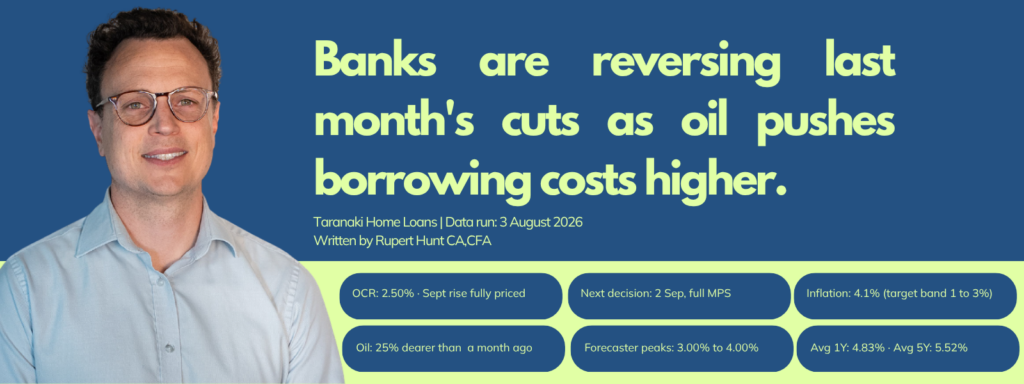
Last month I wrote about the banks cutting their longer fixed rates as oil fell. They are now busy reversing those cuts. The Middle East conflict widened again in late July, oil is about 25% dearer than it was a month ago, and the June quarter inflation number came in at 4.1%, well outside the Reserve Bank’s 1 to 3% target band. The wholesale rates banks pay to fund fixed lending have climbed about 0.35 percentage points since late June, and fixed mortgage rates are following.
July was an interesting month. Pricing diverged as banks reacted slowly to the rise in wholesale rates, having only just adjusted their pricing down the month before. This created opportunities to negotiate and also to secure a good rate before banks passed on the higher wholesale rates (more on this below). This month I expect the banks to price much closer together, unless we get more wholesale volatility from changes in the Middle East situation.
The Reserve Bank lifted the OCR to 2.50% on 8 July, and this started an increase in wholesale rates that continued during the month as the Middle East conflict re-escalated. The two-year wholesale rate went from about 3.3% in late June to a peak of about 3.8% in late July.
The banks reacted more slowly than expected but by the end of the month most had lifted their fixed rates by 0.10 to 0.25 percentage points, depending on the bank and term, which puts them back to about where they sat in late May.
| Bank | 1YR | 18M | 2YR | 3YR | 5YR |
|---|---|---|---|---|---|
| ANZ | 4.79 | 5.19 | 5.29 | 5.49 | n/a |
| ASB | 4.75 | 5.09 | 5.25 | 5.29 | 5.59 |
| BNZ | 4.79 | 5.09 | 5.29 | 5.29 | 5.49 |
| Kiwibank | 4.75 | n/a | 5.19 | 5.39 | 5.69 |
| Westpac | 4.99 | 5.35 | 5.45 | 5.35 | 5.49 |
| SBS | 4.79 | 5.09 | 5.29 | 5.29 | 5.49 |
| TSB | 4.79 | 5.19 | 5.25 | 5.59 | 5.99 |
ANZ has no 4 or 5-year special. A month ago the one-year started with a 4.65. Those rates are gone, and I expect the banks still showing 4.75 and 4.79 to reprice in the coming weeks.
Oil is the main driver again, up 25% on where it was a month ago as the Middle East conflict reignited. Similar to what we saw in March / April this increased wholesale rates particularly 2 years and longer as it increases the risk that inflation will persist and interest rates will have to increase to offset it.
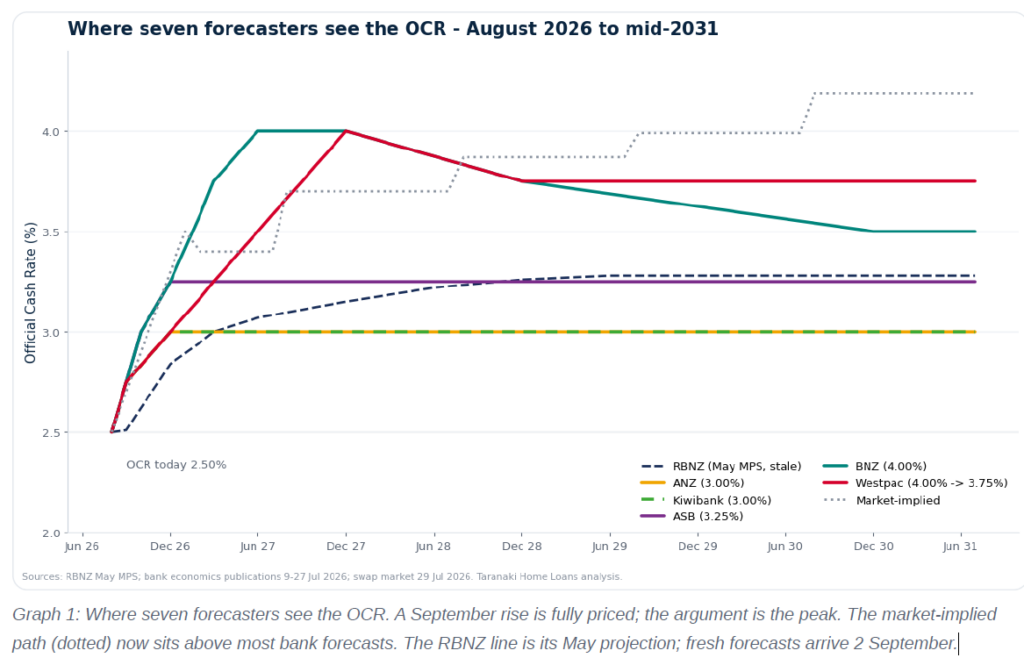
The Reserve Bank raised the OCR in early July which was actually quite interesting as at the time the market was divided around the need for that given oil prices had just come right down. The market has now fully priced a September increase to 2.75%, and sees the cash rate around 3.15% by December, and around 3.8% by the end of 2027.
Economists are still divided on how far the OCR will go. ANZ and Kiwibank pick a peak of 3.00%, ASB picks 3.25% by the end of the year. Westpac sees 3.75% within a year and 4.00% eventually.
A few clients have asked me why it took banks so long to adjust their pricing in response to the rise in wholesale rates in July. Banks don’t get all their funding from the wholesale market. Most of it comes from retail term deposits, which means they can wait and see whether a move in wholesale rates will stick or reverse, and wait for other banks to move first.
We saw this recently. One bank moved its rates up early, the others didn’t follow, and it ended up reversing the increase, then moving again once the rest had adjusted. Changing pricing too often is confusing for customers and creates operational challenges for the bank.
One good thing about wholesale rate volatility like we saw in July is that it creates opportunities. Break fees are always calculated off the wholesale or swap rates, so when swap rates increase, break fees reduce. Sometimes they reduce to very little or nothing, while the banks usually take a while to pass the move on to their pricing. This is where we find our clients opportunities to break and refix on to a lower rate, and it came up a lot in July.
Some examples were borrowers who fixed at 5.8 to 6.7% between 2022 and 2024, who could break for very little and lock in under 5% before the repricing came through. I ran the numbers across every fixing
month and term since 2021. For a lot of those groups the saving was $1,000 to $1,800 for every $100K of loan, after paying the fee.
Part of what Taranaki Home Loans clients get is a system that re-checks every customer’s loan daily against wholesale pricing. When the maths moves in your favour, we get in touch.
I still expect the OCR to climb gradually, with another rise in September and probably one more before Christmas, then a peak around 3.00 to 3.25% in early 2027. That’s closer to ANZ, ASB and Kiwibank than to the 4% picks. The risk to that view is clearly on the high side now: if oil stays where it is, inflation holds near 4% for the rest of the year and the Reserve Bank keeps going.
These are advertised rates, and most borrowers settle below them. More on that next. The obvious risk in either direction is the Middle East. If the fighting winds down, oil, wholesale rates and then fixed rates come back down.
Sometimes the advertised rates are the best rates available, but usually customers can get a rate discounted up to 20 points below the advertised rates, because banks keep a margin up their sleeve for negotiation. I can’t publish the exact rates available that way, but I can estimate them. Right now I’d put the achievable rates at about 4.69% for one year, around 5.10% for two years, 5.29% for three and 5.49% for five. Those are estimates, not offers, and what you’re offered depends on your situation.
I ran my full five-year comparison on a $750K loan against each forecaster’s track, using those achievable rates. Rolling the one-year is still the cheapest path under every forecast, by $22,000 to $30,000 against a five-year fix under the lower peaks, and by less under the 4% picks. The two-year deserves attention too. Banks are discounting the one and two-year terms a bit harder than the three-year, so the two-year beats the three-year on cost under every forecast I run. A week ago, at just under 5%, it was strong enough that rolling two-year fixes beat everything else under the hawkish forecasts. At around 5.10% that edge has gone, but it remains the cheaper way to buy certainty than the three-year.

As always, remember to rate hold. Ask your bank, or ask me, to lock in current pricing. It’s free and usually good for up to 60 days. If rates rise before you refix, you keep the held rate. If something better turns up, you take that instead.
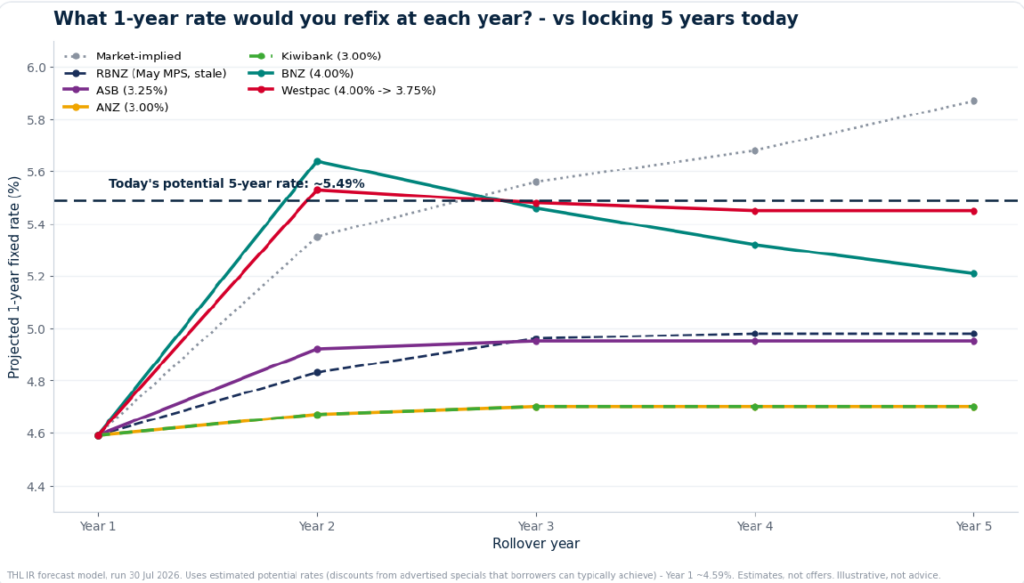
Graph 2: Projected 1-year rate at each annual rollover under each forecaster’s path, using estimated potential rates (estimates of what borrowers can typically achieve below the advertised specials; not offers). Dashed line is today’s potential 5-year rate of about5.49%. Every published track’s rolling average sits below it; under market pricing the gap has nearly closed.
First-home buyers
get the pre-approval and rate lock sorted before you go shopping. The gap between banks on the one-year is about $110 a month on a $750K loan, so which bank you go with is a live decision, not an afterthought.
Refinancers
cashbacks of $7,000 to $9,000 on larger loans are still around, and the wide gaps between banks add to the case for moving, particularly if your bank has repriced and others haven’t. Watch the clawback if you might move again within a few years.
Staying put
get a rate hold as soon as your refix window opens, then take your time. And if you fixed at higher rates between 2022 and 2024, ask me to check your break position. Some of July’s opportunity is still there, and I check daily.
Fixed rates follow banks’ wholesale borrowing costs, not the OCR directly. Those costs have risen about 0.35 percentage points since late June. Part of that is the OCR rise, but most of it is global: dearer oil has pushed interest rates up around the world, and New Zealand imports that pressure.
If your refix is coming up in the next couple of months, yes. Get a rate hold now. Banks reprice in stages, and the ones still showing pre-rise specials are likely to follow. A hold costs nothing and locks today’s pricing for up to 60 days.
The market treats it as a certainty, and every major bank economist expects it. 2 September is a full Monetary Policy Statement, so we’ll also get the Bank’s updated forecasts that day, the first since May.
The best of the July window has been taken by the banks’ repricing, but not all of it. Break fees are still low for many 2022 to 2024 borrowers, and some pre-rise pricing is still on display. It’s a case-by-case calculation. The fee your bank quotes is the one that counts, and cashback clawback can undo the maths, so get it checked before acting.
Usually, yes. Banks hold back a negotiation margin below their advertised specials, and an adviser can often secure some or all of it. I can’t publish those rates, but my estimates of what’s currently achievable sit meaningfully below the advertised cards, especially at one and two years. It costs nothing to ask.
Rate hold first, decision second. Then it’s the usual trade-off: rolling the one-year is cheapest on the forecasts, and the two-year buys certainty for less than the three-year. Don’t take the advertised rate as final either. Ask what’s actually available; the gap is bigger than usual this month.
A month ago rates were drifting down. Now they’re climbing, and the banks are passing it on one at a time. While that lasts there are unusually wide gaps between banks, some pre-rise pricing still on display, and better rates than advertised available if you ask. Get a rate hold the moment your refix window opens. Roll the one-year if cost matters most. If you want certainty, the two-year is better value than the three-year, though not as good as it was a week ago. I still can’t make a case for the five-year. And your rate isn’t only about the term. It’s about which bank, and what you ask for. Talk it through with an adviser before you refix.
Reserve Bank
Free Mortgage Review Information
Strategy comparison: 5-year total interest on a $750K loan (estimated potential rates)
| Forecast track | Roll 1Y | Roll 2Y | Roll 3Y | Fix 5Y | Cheapest |
| ANZ (peak 3.00%) | $176,044 | $182,850 | $190,275 | $205,875 | Roll 1Y |
| Kiwibank (peak 3.00%) | $176,044 | $182,850 | $190,275 | $205,875 | Roll 1Y |
| ASB (peak 3.25% by end-26) | $183,544 | $188,475 | $194,025 | $205,875 | Roll 1Y |
| RBNZ (May track, stale) | $183,328 | $188,981 | $194,475 | $205,875 | Roll 1Y |
| BNZ (peak 4.00%) | $197,450 | $197,030 | $198,771 | $205,875 | Roll 2Y (marginal) |
| Westpac (4.00% → 3.75%) | $199,559 | $199,920 | $201,525 | $205,875 | Roll 1Y |
| Market-implied | $203,675 | $205,419 | $206,425 | $205,875 | Roll 1Y |
| Decision | Breakeven | Read |
| 1Y / 2Y | 5.49% | The hawkish tracks’ year-2 rates clear it (BNZ 5.65, Westpac 5.54), so this one depends on your view |
| 2Y / 3Y | 5.69% | No track’s year-2 rate reaches it; the 2-year beats the 3-year under every forecast |
| 5Y average OCR | ~3.64% | Above every published forecast’s five-year average |
How to read these.
Fixed rates already build in where the market expects the OCR to go. The breakeven is the rate at which paying up for the longer term actually pays off.
1Y/2Y (5.49%):
fixing two years at about 5.09% beats rolling two one-year fixes only if the one-year rate a year from now is above 5.49%. The BNZ and Westpac tracks get there(5.65 and 5.54); the dovish tracks sit below 4.8%. Under the BNZ track rolling two-year fixes comes out marginally ahead of rolling one-years; everywhere else the one-year wins.
2Y/3Y (5.69%):
fixing three years only beats a two-year followed by a one-year if the one-year rate in two years is above 5.69%, which no forecast reaches. Because banks discount the two-year and not the three-year, the two-year wins everywhere.
5Y average OCR (~3.64%):
a five-year fix only pays off if the OCR averages above that for five years; no published forecast averages that high.
The real decision is what certainty is worth to you. On the numbers, staying shorter is cheaper unless rates run well above the bank forecasts, and this month the market is pricing closer to the hawks than the economists are.
Source: THL IR forecast model run 30 July 2026 (strategy tables refreshed 31 July; public anchors 1Y 4.69 and 2Y 5.09 per Rupert), basis +0.20%, RBNZ B2 swap close 29 July. Tracks: ANZ (peak 3.00%), ASB (peak 3.25%), BNZ (peak 4.00% easing to 3.50% by 2030), Westpac (3.75% in a year, peak 4.00% easing 3.75%), Kiwibank (peak 3.00%, constructed from published commentary), RBNZ (May MPS, stale; refreshed 2 Sept), market-implied from the 29 Jul curve. Strategy tables use estimated potential rates, my estimates of rates typically achievable below advertised specials (1Y ~4.69 · 2Y ~5.09 · 3Y 5.29 · 5Y 5.49);estimates, not offers, and your rate will depend on your situation. Illustrative simple-interest basis.
Taranaki Home Loans · August Rate Strategy · General information only, not personalised financial advice. Figures are illustrative and use advertised special rates (<80% LVR) unless noted as estimates. Your situation will differ. Talk to an adviser before deciding. Rupert Hunt is a New Zealand financial adviser.