

The Reserve Bank raised the official cash rate to 2.75% on 2 September, which was expected. However this more directly impacts the floating mortgage rates rather than fixed mortgage rates. Fixed mortgage rates are priced off swap rates and have moved significantly over the last 6 months reflecting the expectation of these hikes that were already priced in. So we might not see too much movement in fixed mortgage rates over September.
For anyone refixing over the next few months, the more consequential development took place in wholesale markets rather than at the Reserve Bank. Through August the swap rates for fixed terms kept climbing, and they now imply a cash rate averaging 3.80% over five years and still rising at the end of that period. None of the published economic forecasts expect that. ANZ and Kiwibank see a peak of 3.00%, ASB 3.25%, and the Reserve Bank’s own new projection peaks at 3.28% in 2029. Even BNZ and Westpac, who both expect 4%, have it easing back afterwards. Since fixed mortgage rates are priced off those wholesale rates, a longer term means paying for a path nobody is currently forecasting.
August was a catch-up month. Swap rates rose sharply in July while advertised mortgage rates barely moved, and over August the banks closed most of that gap. One-year specials went from a 4.75% to 4.99% range up to 4.95% to 4.99%, and two-year rates moved about the same. BNZ and Kiwibank were the slowest in July and have both now repriced.
| Bank | 1YR | 18M | 2YR | 3YR | 5YR |
|---|---|---|---|---|---|
| ANZ | 4.99 | 5.45 | 5.49 | 5.59 | n/a |
| ASB | 4.99 | 5.35 | 5.45 | 5.45 | 5.59 |
| BNZ | 4.99 | 5.29 | 5.45 | 5.45 | 5.49 |
| Kiwibank | 4.95 | n/a | 5.39 | 5.49 | 5.69 |
| Westpac | 4.99 | 5.35 | 5.45 | 5.39 | 5.49 |
| SBS | 4.99 | 5.29 | 5.44 | 5.44 | 5.49 |
| TSB | 4.99 | 5.19 | 5.49 | 5.69 | 5.99 |
| Estimated potential rate | 4.97 | 5.09 | 5.19 | 5.29 | 5.49 |
ANZ has no 5-year special. The bottom row is my estimate of what borrowers can typically achieve below the advertised rate. Estimates, not offers, and not a quote from any bank.
The forecasts differ by a full percentage point at the peak, from 3.00% to 4.00%. They do not really disagree about inflation today. They disagree about how high the cash rate has to go before it starts holding the economy back. The Reserve Bank’s own new projection settles at about 3.28%, so it thinks a little over 3% does the job. Westpac argues policy would not be restrictive even at 3%, and that only a move towards 4% through 2027 starts to bite.
The case for stopping near 3% rests on the economy. Unemployment is 5.6%, the highest in about a decade. Underutilisation is 13.8%, a twelve-year high. Private sector wage growth has slowed to around 2%, and households have been saving more and spending less.
The inflation spike came from fuel after the Middle East conflict, fuel has since come back down, and excluding it inflation was 2.9%. Expectations for inflation one and two years out have fallen since May. On that reading the problem largely sorts itself out and further rises risk overdoing it. Kiwibank’s team has said it expects the increases but disagrees with the need for them.
The case for going to 4% rests on prices rather than activity. Core inflation has sat in the top half of the target band for a long time despite weak growth and rising unemployment. A lot of that is administered prices, meaning council rates, electricity and insurance, which keep rising regardless of demand. Council rates alone are up about 88% over the past decade against roughly 50% for average earnings. The other concern is that businesses set prices ahead of time, so a long stretch of high headline inflation can get built into next year’s pricing before the weak economy pulls it back down. Once that happens it is expensive to undo.
Looking offshore: The US Federal Reserve was read as hawkish after its Jackson Hole meeting, and Australian inflation came in higher than expected, which had forecasters there moving to another rise. Australia’s cash rate is 4.35% against 2.75% here, and if that gap stays wide the New Zealand dollar comes under pressure, which lifts import costs. Both fed through to the front of the New Zealand curve in late August.
Three things will settle the argument. Fuel prices, which decide how quickly headline inflation falls away. The September quarter inflation figure on 21 October, which lands a week before the next cash rate decision. And the labour market, which decides whether the economy can absorb higher rates at all.
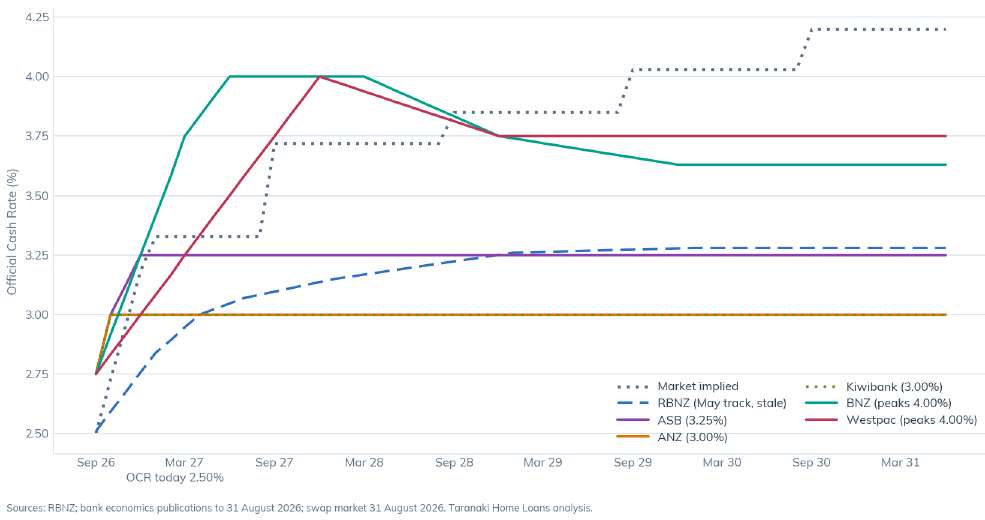
Graph 1: Where each forecaster sees the cash rate, against what wholesale markets are pricing. The market path is the only one still rising at the end of five years.
Fixed rates are not set off the cash rate. They are set off swap rates, which reflect what the market expects the cash rate to average over the whole term. Take the bank’s margin back out of today’s achievable rates and you can see what cash rate each term is priced on. A one-year fix is priced on the cash rate averaging 3.20% over the next year, a two-year on 3.46%, a three-year on 3.59% and a five-year on 3.80%.
Compare that with what the forecasts expect the cash rate to average over the same five years. ANZ and Kiwibank about 3.00%, the Reserve Bank 3.17%, ASB 3.24%, Westpac 3.67%, BNZ 3.70%. None of them reach the 3.80% a five-year fix is priced on, and the gap widens with every extra year of term.
BNZ and Westpac both expect 4%. BNZ gets there in the middle of 2027, Westpac about six months later. But both then ease back, to around 3.6% and 3.75%. A 4% peak is not enough. The cash rate starts at 2.75% and has to climb, so averaging 3.80% over five years means going above 4% and staying there, which neither forecast does. The only path that clears the bar is the market’s own, and that is the price you are being asked to pay.
One bank’s economics team made the case for fixing longer this month, arguing that a longer term protects you while the cash rate is still rising. That is fair, and the more useful question is what the protection costs. On their own forecast it is about $6,768 over five years on a $750K loan, and under the more cautious forecasts it is closer to $29,945. Nobody knows which forecast will be right, and that uncertainty is what the premium buys you out of. So the decision is less about whether fixing longer is right or wrong, and more about how much extra you are willing to pay for the protection.
I still expect the OCR to climb gradually, with another rise in September and probably one more before Christmas, then a peak around 3.00 to 3.25% in early 2027. That’s closer to ANZ, ASB and Kiwibank than to the 4% picks. The risk to that view is clearly on the high side now: if oil stays where it is, inflation holds near 4% for the rest of the year and the Reserve Bank keeps going.
Bank margins are below their long-run levels at most terms, so advertised rates have room to drift higher even if swap rates stop moving. If your refix window is open, that argues against waiting.
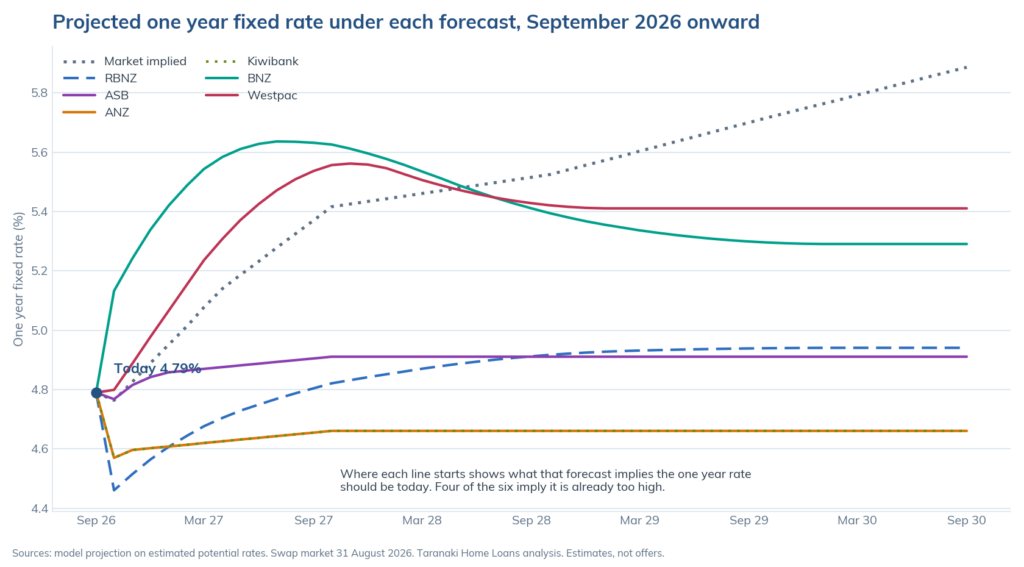
Advertised rates are sometimes the best available, but usually there is room below them because banks keep a margin for negotiation. I cannot publish the exact rates, but my current estimates are about 4.79% for one year, 5.19% for two, 5.29% for three and 5.49% for five. Estimates, not offers, and what you are offered depends on your equity, income and banking relationship.
I ran my five-year comparison on a $750K loan against each forecast, as a real principal and interest loan with the repayment recalculated at every refix. The five-year column is the same in every row, because a five-year fix can only be taken at today’s rate. Only the rolling columns change with whose forecast is right.
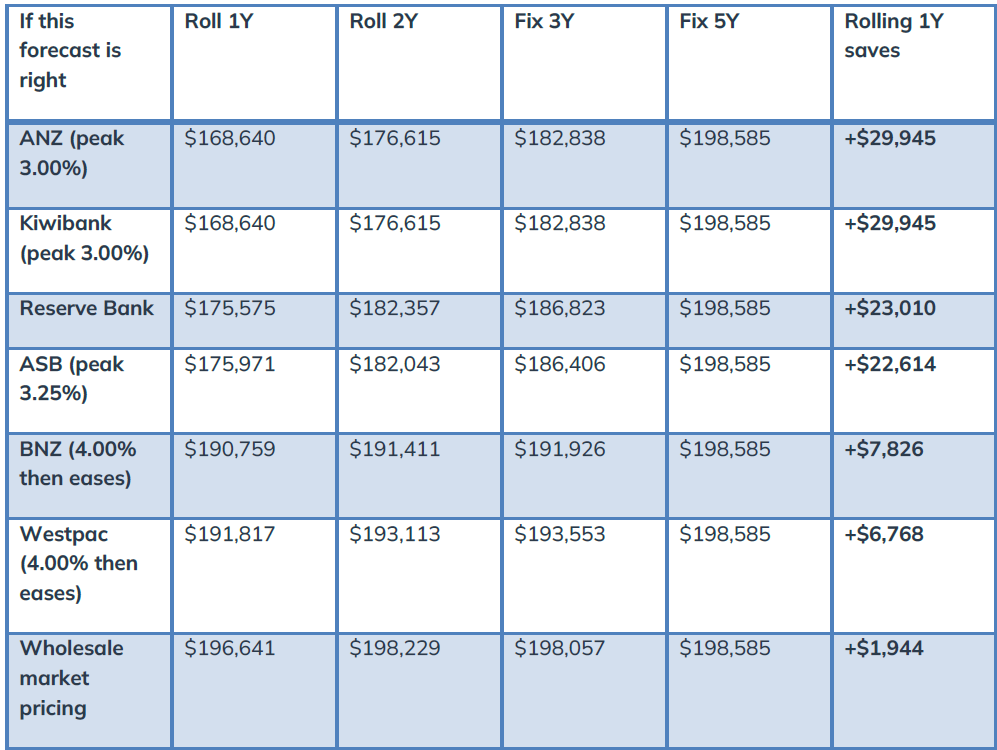
Interest paid over five years on a $750K loan, principal and interest over 30 years, using estimated potential rates. Estimates, not offers.
Rolling the one-year is cheapest in every row. The market row is the close one and I would not put much weight on it, since it turns on where bank margins settle. The six economist rows are not close and they all point the same way.
The same thing as a breakeven, which is how high the rate has to get at your next refix before fixing longer would have been the better call:
| Decision | Breakeven | What would have to happen |
|---|---|---|
| Roll 1Y against fix 2Y | 5.59% | The one-year rate at your first refix has to beat this. No forecast reaches it. |
| Fix 2Y against fix 3Y | 5.49% | The two-year rate in two years has to beat this. |
| Roll 1Y against fix 3Y | 5.54% | The average one-year rate across years two and three has to beat this. |
| Fix 2Y against fix 5Y | 5.69% | The three-year rate in two years has to beat this. |
| What a 5-year fix needs | 3.63% | The average cash rate over five years. The highest forecast averages 3.70%. |
Breakevens on estimated potential rates, before any cash contribution. Estimates, not offers.
| If your priority is | Strategy | Why |
|---|---|---|
| Lowest cost | Roll 1 year | Cheapest under every forecast, by $6,768 to $29,945 over five years. |
| Certainty at a fair price | Fix 2 years | At an estimated 5.19% it is cheaper than the three-year under every forecast. |
| Insurance against the hawkish case | Fix 3 years | Most of a five-year fix’s cover for six to seven thousand dollars less. |
| Not thinking about it again | Fix 5 years | Only wins if the cash rate averages 3.63%, which no forecast reaches. |
| Flexibility to repay or sell | Variable, briefly | Expensive at around 6%. A short fix usually does the same job for less. |
Whichever term you pick, get a rate hold as soon as your window opens. Ask your bank, or ask me. It costs nothing, lasts about 60 days, and if a better rate turns up you take that instead.
Fixed rates follow swap rates, not the cash rate directly, and swap rates reflect what the market expects the cash rate to average over the whole term. The September rise was priced in weeks beforehand. What moved rates over August was the market deciding more rises would follow.
Safe and cheap are different questions. A five-year fix removes the uncertainty and for some people that is worth paying for. But it needs the cash rate to average about 3.80% over five years to come out ahead, and none of the published economic forecasts reach that, including the two expecting 4% before it eases back. On a $750K loan the certainty costs between $6,768 and $29,945 over five years.
If yours is one of the few still showing older pricing, yes, get a rate hold now. Bank margins are below their long-run levels at most terms, so retail pricing is likely to rise from here even if swap rates stop moving.
Usually, yes. Banks hold a negotiating margin below their advertised specials. How much you get depends on your equity, your income, whether your day-to-day banking moves across and how much you are borrowing. The estimates here are what I typically see, not a quote from any bank.
The market prices it at a little better than a coin toss and most economists expect a rise. ANZ, ASB, BNZ and Kiwibank all forecast one in October, though for ANZ and Kiwibank it is the last of the cycle. Westpac expects December instead. The election on 7 November leads some to think October less likely, and BNZ argue the opposite.
Much of it is prices that are not set by competition. Council rates are up about 88% over a decade against roughly 50% for average earnings, and electricity and insurance have moved similarly. Those keep rising regardless of demand, which is why the Reserve Bank is tightening into a soft labour market.
The gap between what swap rates are charging for and what the published economic forecasts expect is the story this month. While it lasts, every extra year of fixed term costs more for a cash rate path none of them describe, including the Reserve Bank’s own. That points to staying short, getting a rate hold in place, and looking again once the gap closes. If your rate expires in the next few months, get the hold first and then talk the term through with an adviser.
Reserve Bank
Free Mortgage Review Information
General information only, not personalised financial advice. Figures are illustrative and use advertised special rates unless noted as estimates. Your situation will differ. Talk to an adviser before deciding. Rupert Hunt is a New Zealand financial adviser.